
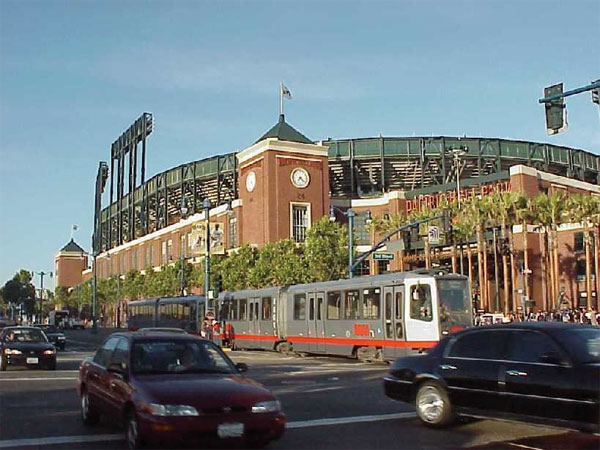
Last winter, the San Francisco Giants migrated to a new $1 million-plus VoIP telecommunications system from ShoreTel for its ballpark, AT&T Park, abandoning--ironically--its legacy system, which was provided by AT&T. According to Schlough, the old system cost $490,000 annually, while the new setup for the 457 phones at the ballpark run the team just $135,000 a year. Given that the minimum salary for Major League Baseball players this year is $400,000, the resulting annual savings of $355,000 is almost enough to pay for a backup second baseman or a rookie relief pitcher. One visceral example of how the new ShoreTel setup is a generational step up from the Giants' old AT&T network is deep in the ballpark's bowels, in what is known as the MPO, or minimum point of entry, its telecommunications infrastructure hub. There, the old system's sets of switches and wiring take up an entire wall. But now, its VoIP setup is doing its job from a single rack in the back of the room. And beyond the cost savings the new system provides, Schlough told a group of reporters gathered Monday night for a discussion of the ballpark's technology, its integrated software for the first time allows the team to do a much better job of proactively identifying callers to its season ticket customer support line and allowing service representatives to see, even before picking up such a call, a set of information about the customer, including whether they've used their tickets to recent games or whether they've sold them on StubHub.com. Previously, Schlough said, the reps would have no idea who a caller was until the conversation had commenced. More than 2.5 percent of the budget - At more than $1 million, the Giants' new phone system is certainly pricey, but Schlough said that given the annual savings, he expects it to pay for itself in just three years. But the phone setup isn't the teams only major recent technology investment. The Giants have also coughed up big money for things like a state-of-the-art high-definition video scoreboard, as well as hundreds of HDTVs that were installed around the ballpark. All told, Schlough told CNET News, when large capital expenditures are included, the Giants spend between 2.5 percent and 3 percent of the team's total annual budget on technology. He did not say what the dollar amount of that annual budget is, but its safe to say it is in the high eight figures or low nine figures, since its payroll alone is $82.6 million and it has an annual debt service of at least $20 million on the privately financed AT&T Park, which opened in 2000. For years, meanwhile, the ballpark has offered its customers free Wi-Fi. In fact, it was among the very first to do so in all of professional sports. And for years, using it meant toting a laptop to the park, something which usually did not sit well with hard-core fans. But Schlough said that the iPhone and iPod Touch era has changed things irrevocably for the ballpark's Wi-Fi system and has inspired the team to offer customers a set of services unlike that available in any other park. He said that the iPhone debuted the same weekend as the Giants hosted the 2007 Major League Baseball All-Star Game and that since then, usage of the park's Wi-Fi network has gone up 537 percent. At a game on April 21, in fact, he said, 1,289 fans connected to the network. And one thing that has changed dramatically since the advent of the iPhone and iPod Touch is when fans are using Wi-Fi. In the early days, Schlough said, usage was almost exclusively during weekday day games, a function of the many businesspeople who came to games with clients. Now, however, he explained, the usage pattern has shifted dramatically, and the lion's share of the usage is during night games. During the 2008 season, Schlough said, there were usually an average of no more than 600 people using the ballpark's Wi-Fi network on any given date. "This year, there were more than 1,000 right out of the box," he said. Customers who do log on to the Wi-Fi network at the park are now able to use an innovative and exclusive system called the Giants Digital Dugout. This offers fans two big benefits. The first is a "food finder," which can direct fans to the closest concession location for the exact kind of food or beverage they want, and the second is a collection of video replay highlights that includes, within three minutes after it happens, any controversial call by an umpire. In Major League Baseball, unlike other sports, ballparks are not allowed to show replays of controversial calls on the scoreboard. So Schlough worried that too much attention to the video replay feature of the Digital Dugout might force the league to shut the Giants' system down. Short of that, though, it is an attractive feature, and well worth bringing an iPhone to the park. It's features like that, however, that are inspiring fans by the hundreds, if not thousands, to get online at the ballpark. But in the early days of the Wi-Fi network at AT&T Park, it was mostly reporters and photographers logging on. In fact, said Schlough, newspapers that were able to run photos in their morning editions the day after former Giants superstar slugger Barry Bonds hit his 660th career home run late in a night game on April 13, 2004, tying his godfather, Willie Mays, for third place on the all-time list, owed a debt of gratitude to the park's Wi-Fi. From the Wi-Fi network description at their main site: http://sanfrancisco.giants.mlb.com/sf/ballpark/wifi.jsp: What is the Giants Digital Dugout? The Giants Digital Dugout is available exclusively at AT&T Park and has been designed to enhance the "fan experience" with unique content, including:
The Digital Dugout is an interactive application developed by the Giants in conjunction with Birdsall Interactive, available to fans via the Giants WiFi Network or computers located in AT&T Park luxury suites.
Tuesday, May 12, 2009
Pac Bell/AT&T Park Technology

Sunday, March 15, 2009
Randy Winn and Bengie Molina Want to Stay in San Francisco, But Will The Economy Let Them?
This offseason has been one of economic turmoil and reality checks. Franchises across all sports are certainly strapped for cash, and the effects of this are certainly showing themselves. When it comes specifically to the MLB, the average contact sizes diminished, both in dollar amounts and years teams were willing to commit to individual players. It was Manny Ramirez who expected to get a four-year, 100 million dollar contract when this season began, and after weeks of drama, complaining, uncertainty, and negotiations, he finally settled on signing with the Dodgers for two years, close to 50 million, about half of what he expected initally. And he has an opt-out clause in his contract after this season. Outside of Ramirez, big-money contracts were a dime-a-dozen, essentially non-existent.
These market conditions relate to the San Francisco Giants in many ways. With all the supposed young talent in the farm system, the front office has been hesitant to say the least about acquiring veteran talent, especially for an extended period of time. The bullpen was an area that changes certainly needed to be made coming into this season, and the Giants quickly addressed that with the signing of Bobby Howry and Jeremy Affeldt. With the loss of Omar Visquel, shortstop was also a gaping whole for the club, and they hope to solve that issue with the addition of Endgar Renteria. They also felt the starting rotation could use one more big arm, a hall of fame arm, so they went out and got Randy Johnson.
The Giants were unwilling to throw money at the 'one-dimensional' Manny Ramirez and prevent him from going back to the Los Angeles Dodgers, but they say this was due to depth in the outfield already present in the club and the risk the team would be taking with the media-whore that Manny Ramirez can be. Another significant reason for why this transaction didn't take place could had something to do with money and the economy.
The limited big-money offers didn't go unnoticed by players who are scheduled to be free agents next winter - including the Giants' Randy Winn and Bengie Molina. Winn batted .306 last year, and Molina led the team with 95 RBIs. Both turn 35 this summer.

"The later the free-agent period got, the contracts weren't as good aside from Manny" Ramirez, Winn said. "I guess I'm an optimist, hoping the economy turns around sooner than later and not just for baseball free agents' sake."
It's no surprise both Winn and Molina said in separate interviews they're open to extensions. Who knows what the atmosphere surrounding baseball will be like next season. Unfortunately, it's difficult. The Giants have younger players with smaller salaries preparing to replace Winn and Molina. It's expected that right fielder Nate Schierholtz and catcher Buster Posey will be in the 2010 Opening Day lineup, but neither is as much a sure thing, at least for now, as Winn and Molina.
"I love San Francisco. I love the Bay Area," Winn said. "It's documented I grew up there. High school, college, all that. My family's there. My friends are there. The people in the front office have treated me very fairly. I'd love to stay."


So would Molina. "I want to talk to them or have them talk to me, either way," Molina said. "It would make me feel like they want me and like what I do. I love these guys. I'm thinking this is my priority right now, to stay here."
Rather than discuss extensions, the Giants prefer to have the season play out. "It's a good question, but not an easy answer because the economy is uncertain for both the club and the players," said Bobby Evans, vice president of baseball operations. "It's in both parties' best interest to wait and see what happens with the economics of the sport."
The market was less than lucrative for many free agents in their mid-30s. Bobby Abreu took an $11 million pay cut, and Red Sox catcher Jason Varitek sought Jorge Posada money but had his salary slashed in half. "When you're a free agent, you need teams that want you and are willing to pay for what you've done in your career, what you've done last year and what they think you can do in the future," Molina said. "At the same time, things happen."