
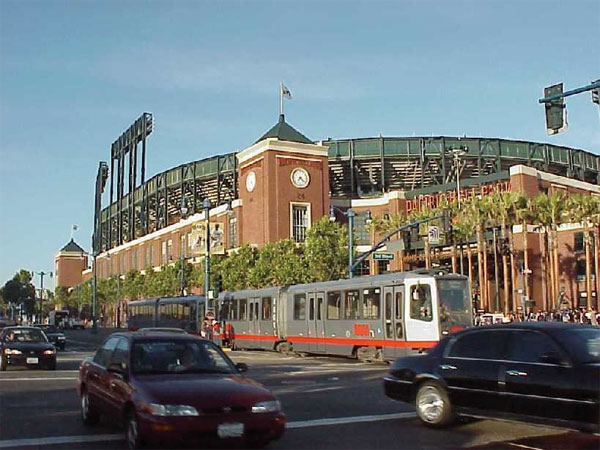
Last winter, the San Francisco Giants migrated to a new $1 million-plus VoIP telecommunications system from ShoreTel for its ballpark, AT&T Park, abandoning--ironically--its legacy system, which was provided by AT&T. According to Schlough, the old system cost $490,000 annually, while the new setup for the 457 phones at the ballpark run the team just $135,000 a year. Given that the minimum salary for Major League Baseball players this year is $400,000, the resulting annual savings of $355,000 is almost enough to pay for a backup second baseman or a rookie relief pitcher. One visceral example of how the new ShoreTel setup is a generational step up from the Giants' old AT&T network is deep in the ballpark's bowels, in what is known as the MPO, or minimum point of entry, its telecommunications infrastructure hub. There, the old system's sets of switches and wiring take up an entire wall. But now, its VoIP setup is doing its job from a single rack in the back of the room. And beyond the cost savings the new system provides, Schlough told a group of reporters gathered Monday night for a discussion of the ballpark's technology, its integrated software for the first time allows the team to do a much better job of proactively identifying callers to its season ticket customer support line and allowing service representatives to see, even before picking up such a call, a set of information about the customer, including whether they've used their tickets to recent games or whether they've sold them on StubHub.com. Previously, Schlough said, the reps would have no idea who a caller was until the conversation had commenced. More than 2.5 percent of the budget - At more than $1 million, the Giants' new phone system is certainly pricey, but Schlough said that given the annual savings, he expects it to pay for itself in just three years. But the phone setup isn't the teams only major recent technology investment. The Giants have also coughed up big money for things like a state-of-the-art high-definition video scoreboard, as well as hundreds of HDTVs that were installed around the ballpark. All told, Schlough told CNET News, when large capital expenditures are included, the Giants spend between 2.5 percent and 3 percent of the team's total annual budget on technology. He did not say what the dollar amount of that annual budget is, but its safe to say it is in the high eight figures or low nine figures, since its payroll alone is $82.6 million and it has an annual debt service of at least $20 million on the privately financed AT&T Park, which opened in 2000. For years, meanwhile, the ballpark has offered its customers free Wi-Fi. In fact, it was among the very first to do so in all of professional sports. And for years, using it meant toting a laptop to the park, something which usually did not sit well with hard-core fans. But Schlough said that the iPhone and iPod Touch era has changed things irrevocably for the ballpark's Wi-Fi system and has inspired the team to offer customers a set of services unlike that available in any other park. He said that the iPhone debuted the same weekend as the Giants hosted the 2007 Major League Baseball All-Star Game and that since then, usage of the park's Wi-Fi network has gone up 537 percent. At a game on April 21, in fact, he said, 1,289 fans connected to the network. And one thing that has changed dramatically since the advent of the iPhone and iPod Touch is when fans are using Wi-Fi. In the early days, Schlough said, usage was almost exclusively during weekday day games, a function of the many businesspeople who came to games with clients. Now, however, he explained, the usage pattern has shifted dramatically, and the lion's share of the usage is during night games. During the 2008 season, Schlough said, there were usually an average of no more than 600 people using the ballpark's Wi-Fi network on any given date. "This year, there were more than 1,000 right out of the box," he said. Customers who do log on to the Wi-Fi network at the park are now able to use an innovative and exclusive system called the Giants Digital Dugout. This offers fans two big benefits. The first is a "food finder," which can direct fans to the closest concession location for the exact kind of food or beverage they want, and the second is a collection of video replay highlights that includes, within three minutes after it happens, any controversial call by an umpire. In Major League Baseball, unlike other sports, ballparks are not allowed to show replays of controversial calls on the scoreboard. So Schlough worried that too much attention to the video replay feature of the Digital Dugout might force the league to shut the Giants' system down. Short of that, though, it is an attractive feature, and well worth bringing an iPhone to the park. It's features like that, however, that are inspiring fans by the hundreds, if not thousands, to get online at the ballpark. But in the early days of the Wi-Fi network at AT&T Park, it was mostly reporters and photographers logging on. In fact, said Schlough, newspapers that were able to run photos in their morning editions the day after former Giants superstar slugger Barry Bonds hit his 660th career home run late in a night game on April 13, 2004, tying his godfather, Willie Mays, for third place on the all-time list, owed a debt of gratitude to the park's Wi-Fi. From the Wi-Fi network description at their main site: http://sanfrancisco.giants.mlb.com/sf/ballpark/wifi.jsp: What is the Giants Digital Dugout? The Giants Digital Dugout is available exclusively at AT&T Park and has been designed to enhance the "fan experience" with unique content, including:
The Digital Dugout is an interactive application developed by the Giants in conjunction with Birdsall Interactive, available to fans via the Giants WiFi Network or computers located in AT&T Park luxury suites.
Tuesday, May 12, 2009
Pac Bell/AT&T Park Technology

Monday, April 20, 2009
CBS Pushes NFL to Stream Super Bowl 2010 Online
Ian Paul, PC World Apr 20, 2009 10:32 am CBS wants to offer a live online video stream of next year's Super Bowl XLIV from Miami and the NFL just might say yes. This isn't your usual tech rumor, either; the announcement that CBS, the fficial broadcaster for Super Bowl XLIV, wants to stream the mega-popular sporting event comes from CBS Interactive President Quincy Smith, according to Business Week. In the same report, Brian Rolapp, the NFL's senior vice-president for media strategy, says the NFL "would be open" to CBS' proposal. That's not a firm guarantee, but with two named sources from CBS and the NFL openly discussing the idea, Super Bowl streaming may be just around the corner even if we don't see it in 2010. The possibility of the Super Bowl hitting the Web comes on the heels of recent successes for CBS and its online sports programming. During its television broadcasts of NCAA basketball's March Madness 2009, CBS hauled in millions of dollars from big-ticket advertisers. Even more shocking is the claim that the network managed a modest, ad-supported profit from its online streaming of the college tournament (in 2008 for the first time; this year the stream also went to the iPhone). While other online content streaming sites may be struggling to make money online, CBS and others are finding that live sports can bring in some money from online audiences. Since it's a live event, fans are already more tolerant of online commercials during half-time and time outs, Arash Amel, broadband analyst for the research firm Screen Digest told Business Week. Amel also said those same sports fans taking in ads during games usually grate at seeing too many commercials while streaming an episode of their favorite television program. The ability to watch sports online is also a privilege that some are willing to pay for. Major League Baseball has been working on its MLB.TV venture for three years now, and while it's a little rough around the edges it is a very competent service. The NHL has also been dipping its toes in the online streaming waters with the NHL GameCenter Live and the NBA has its League Pass for international online viewers. Even the NFL offers live online streaming for football fans outside of North America and the United Kingdom through its NFL GamePass. Gridiron fans also got a treat when the NFL and NBC streamed Sunday Night Footballto U.S. residents during the 2008-2009 regular season. The NFL found that online streaming was largely used by millions of viewers as a supplement to the television broadcast, Rolapp told Business Week. That's not surprising to me, since I was one of the millions using the online stream to get different game angles while also keeping my television tuned to the NBC broadcast. Streaming the Super Bowl would be a smart move for the NFL. Let's face it; there are already many illegitimate streaming sites where you can view most major professional sports. NBC learned that lesson during the 2008 Summer Olympic Games in Beijing. The network embraced the Internet by streaming and posting thousands of hours of Olympic coverage online; however, it was taken by surprise when U.S. viewers had numerous options to watch the more popular Olympic sports online before their scheduled broadcast time on NBC. For the 2010 Winter Olympics in Vancouver, NBC plans an authentication wall for cable subscribers, which will inevitably push those who want to see the Olympics via the web to the multitude of rogue streaming sites. NBC's authentication wall is the wrong move. The network is only setting itself up for defeat in a battle that other content producers like the record labels and movie studios are already losing. By embracing the Web and providing high-quality, accessible streams for major sporting events, broadcasters will bring viewers in droves to their sites and may find they are enhancing, not cannibalizing, their television audience.

